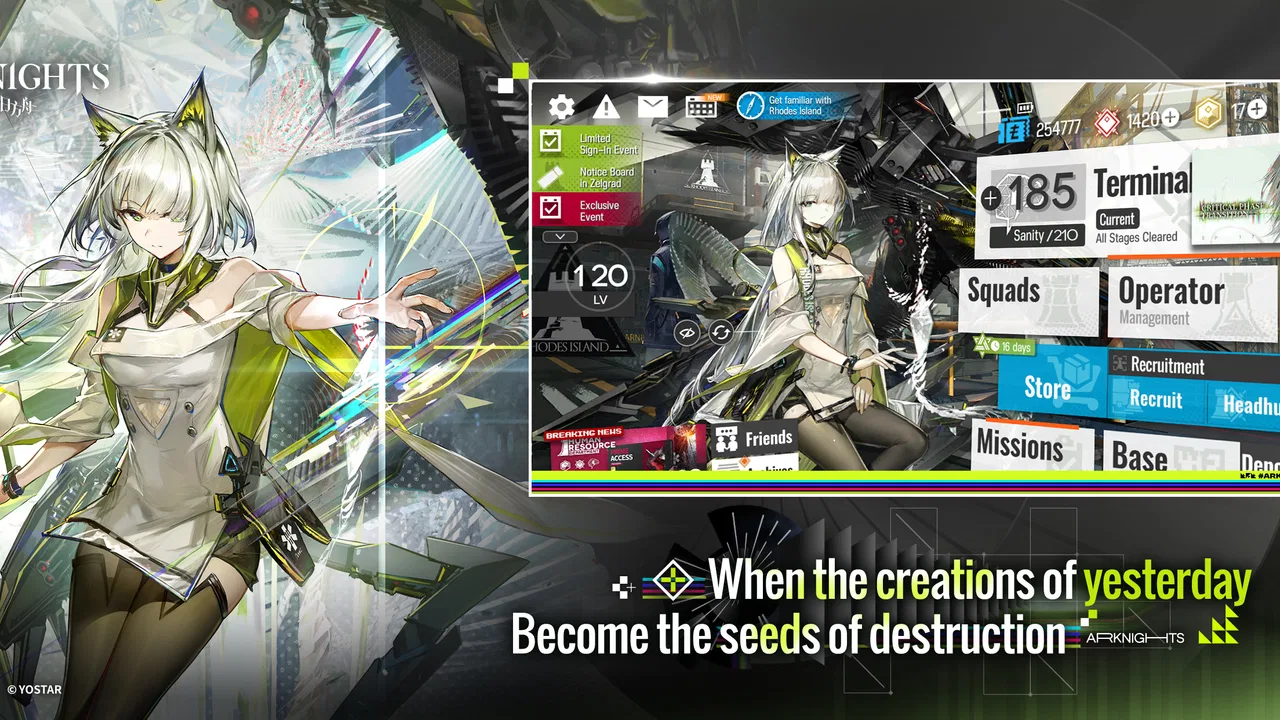
Arknights
- 4.4
- Rating
- 5.00M
- Installs
- Free
- Price

 Analysis by App-foxy
I spent time with Arknights as a strategy game built around one central skill: making careful decisions with a limited team while a battle keeps changing in front of you. That sounds simple, but the appeal comes from how much weight each placement, timing choice, and retreat can carry. I rarely felt that success came from merely having stronger characters. More often, I had to understand the map, identify the real threat, and decide which part of my plan could be sacrificed.
That makes this a very different experience from a casual game where I can tap through a stage and let upgrades do most of the work. It is free to start, developed by Yostar Limited, and aimed at a Teen audience. The game has built a substantial player base, with over five million installs and a 4.3 average from roughly 204 thousand ratings. Those figures fit my impression: this is a polished, established title with enough depth to reward players who enjoy learning systems rather than simply collecting content.
Why Arknights’ tactical deployment matters
The most important capability here is the ability to deploy operators into specific positions and then manage the battlefield around those decisions. Your units do not simply attack whatever is nearest in a general sense. Their location, direction, role, timing, and available skills all affect whether a lane holds or collapses. I found myself treating every stage like a small puzzle instead of a conventional level.
You May Also Like

 Blood Strike: 2.5 Anniversary
Blood Strike’s Loadouts Turn Every Drop Into a Tactical Gamble
A close look at Blood Strike’s custom loadouts: how fast access to signature weapons reshapes its battle royale rhythm, rewards preparation, and narrows the gap between fights.

 Pandora - Music & Podcasts
Pandora’s Music Is Easy to Start, but Harder to Recover
Pandora’s strength is its low-effort path from a seed to a station. Its weak spot is how much confidence it asks you to place in connection, setup, and quiet recovery.

 8 Ball Pool
 Is Built on Rivalries, Rematches, and Routine
A close look at the rivalries, rematches, shared routines, and unanswered safety questions that turn a quick pool match into a persistent mobile community.

 Samsung Music
’s Quiet Strength Is Playing What You Already Own
Its reach comes less from spectacle than from dependable access to a personal library. That simplicity is both the app’s strongest retention engine and its ceiling.

 AccuWeather: Weather Radar
AccuWeather Review: A Quick, Clear Forecast for Everyday Decisions
For everyday plans, the best forecast is the one you can understand quickly. AccuWeather makes rain timing, radar, and local conditions easy to act on, with a few trade-offs.

 Hill Climb Racing
Why Hill Climb Racing Still Turns Crashes Into One More Run
A tiny car, a bumpy hill and one more upgrade: Hill Climb Racing keeps resurfacing because its simple chaos makes every near-miss feel personal.
More From Our News Desk



That design gives the game a satisfying kind of pressure. A strong defender placed too early may block enemies successfully but leave the rest of the formation without enough damage. A damage dealer positioned safely may contribute less than expected if the attack direction is wrong. A healer can stabilize a lane, but placing that healer where the team cannot protect them creates a new problem. The useful question is rarely “Which operator is strongest?” It is usually “What does this map require first?”
The real strength is not raw power; it is the freedom to solve the same tactical problem in different ways. I could sometimes use a safer, slower formation, while another attempt favored quick deployment and aggressive skill timing. This flexibility is what separates the game from many mobile strategy titles that reduce combat to automatic team comparisons.
How a stage feels when the plan starts to move
Before a battle begins, I look at the route enemies will follow, the available deployment spaces, and the likely points where several threats will meet. That preparation matters because a poor opening can make the rest of the stage feel impossible. I learned to avoid spending every deployment option immediately. Keeping one position open for an emergency unit or saving a skill for a dangerous wave often mattered more than adding another attacker early.
Once the stage starts, the rhythm becomes a sequence of small decisions. I place an operator, watch the lane, wait for the deployment resource to recover, and decide whether to reinforce, activate a skill, or retreat someone who has done their job. Retreating is especially important. It is not simply admitting that a unit failed; it can be part of the plan. Removing an operator at the right moment can free a valuable space or allow a more suitable specialist to enter later.
This is where the game asks for more attention than a typical idle or auto-battle alternative. I cannot always treat a stage as background entertainment. Even when the opening is familiar, a single late enemy can expose a weakness in my formation. I enjoyed that tension, but I also understand why someone looking for a hands-off experience may find it tiring.
One practical habit helped me more than repeatedly changing my whole squad: I first watched a failed attempt and identified the earliest point where the formation became unstable. If the problem was an unprotected lane, I changed the opening. If the issue was a skill arriving too late, I adjusted timing rather than replacing the operator. This approach made progress feel earned and reduced the temptation to spend resources randomly.
The difference between learning and simply upgrading
Progression still matters, and stronger operators can make difficult stages more forgiving. However, improvement does not erase the need to understand roles. A well-developed unit placed in the wrong lane can be less useful than a more modest option that fits the situation. That is one reason I found the game more mentally engaging than many collection-focused competitors.
It also creates a trade-off for new players. The roster and terminology can feel dense at first, especially when several operators appear to fill similar jobs but behave differently. I recommend resisting the urge to develop everyone at once. A smaller group that covers the basic needs of a stage is easier to understand, easier to deploy consistently, and less expensive in attention and materials.
Another useful workflow is to keep a few dependable operators for general situations while experimenting with one flexible slot. That way, a failed experiment does not destroy the entire plan. Over time, I started recognizing which problems called for stronger blocking, wider damage, healing support, or a temporary answer rather than trying to force the same team through every map.
A realistic evening with the game
Imagine having a short break after work and wanting to play for twenty minutes. Arknights can fit that window, but only if you choose the right activity. A familiar stage may be comfortable for routine progress, while a new challenge can consume the whole session because you will want to retry it after understanding the first failure. I often began with the intention of completing one task and ended up replaying the opening several times because one adjustment looked promising.
That is both a strength and a limitation. The game respects short sessions when I already know what I am doing, but it is less convenient when I want instant, low-effort entertainment. A commute or waiting room can be suitable for a quick check-in, yet a difficult stage deserves enough concentration to notice enemy timing and manage skills properly. I would not choose it as my main game if I wanted something I could play with the sound off and almost no attention.
Where the strategy becomes especially rewarding
The best scenario for me was a stage where the obvious solution worked for the opening but failed later. Those maps encouraged me to think in phases. I had to build a stable start, preserve enough resources for the middle, and prepare for the point where the enemy pattern changed. The satisfaction came from seeing a plan develop rather than discovering that one overpowered unit solved everything.
This is also where retreat timing becomes a surprisingly advanced tool. A unit that blocks early enemies may not be needed once the lane changes. Leaving it in place can waste a deployment slot, but removing it too soon can expose the route. I learned to view operators as temporary pieces in a larger sequence, not permanent fixtures. That perspective made my formations more adaptable.
Another non-obvious lesson is that failure can reveal a resource problem rather than a character problem. If I activated every ability as soon as it became available, I often had nothing ready for the critical wave. Waiting a few seconds could produce a much stronger result. The game rewards patience, but not passive patience: I still needed to watch the battlefield and predict what was approaching.
What can frustrate new players
The learning curve is the clearest friction point. The first successful stages may suggest that basic placement is enough, but later encounters can demand more careful sequencing. Players who prefer immediate clarity may find the number of operators, roles, and possible team combinations overwhelming. I would have appreciated a gentler path into the deeper tactical habits, although the complexity is also what gives the game longevity.
There is another emotional trade-off in the collection structure. The game is free to play, but it includes in-app purchases ranging from $0.99 to $99.99 per item. I never think of that range as a reason to dismiss the game automatically, but it does mean that players should decide their spending boundaries before getting invested. The tactical design is strong enough that I would approach purchases as optional convenience or collection choices, not as the foundation of the experience.
For someone who dislikes repeating stages, the need to learn through retries may also become a weakness. I enjoyed revisiting a level when I had a specific hypothesis to test. I enjoyed it much less when I was unsure whether the problem was my timing, my squad, or my understanding of the stage. Keeping notes mentally, or changing only one variable at a time, makes the process less frustrating.
How it compares with more familiar mobile strategy games
Compared with auto-battlers, Arknights gives me more direct responsibility during combat. In an auto-battler, much of the challenge usually comes before the fight through team composition, upgrades, or positioning. Here, preparation matters, but the battle itself remains active. I must decide when to deploy, when to activate abilities, and when to remove a unit. That makes the experience more demanding but also more personal.
Compared with traditional tower defense, it feels less static. The units are not just fixed towers that remain on the map until the end. Deployment order, retreating, and skill timing let me reshape the defense while the stage is running. That makes the game closer to managing a moving formation than simply building a wall.
Players coming from character-collection games may recognize the appeal of developing a roster, but the tactical layer changes the value of that roster. A unit is not automatically useful because it is rare or powerful. Its value depends on what it can contribute to a particular map and how comfortably it fits the player’s style. I found that encouraging because it made experimentation worthwhile, though it also meant I had to spend time learning what each operator actually did.
Who will get the most from it
I would recommend Arknights to players who like pausing to think, testing a plan, and improving through observation. It is especially suitable for someone who enjoys strategy games in which positioning and timing matter as much as long-term progression. If you like solving a stage with a limited set of tools, the game can remain interesting long after the basic controls become familiar.
It is also a good fit for players who want a free game they can approach gradually. You do not need to treat every session as a long commitment, but you should be willing to spend more time on unfamiliar stages. The Teen rating is worth keeping in mind for families and younger players deciding whether the tone and presentation suit them.
I would suggest skipping it if your priority is a completely automatic experience, a very small roster, or a game that explains every system immediately. I would also look elsewhere if you dislike retrying a level after a tactical mistake. A simpler tower defense game may be more relaxing, while an auto-focused strategy title may better match a player who wants planning without active intervention.
Practical advice before committing
Start by learning the behavior of a manageable core team instead of chasing every new option. Pay attention to what happens when an operator is deployed early, what changes after a skill is used, and how much space remains for a later response. This gives you a reliable foundation for judging new units instead of assuming every problem requires a completely new squad.
When a stage defeats you, do not immediately conclude that you need more upgrades. First ask whether the failure happened because of placement, timing, lane coverage, or a lack of reserve resources. That diagnosis is often more valuable than another round of development. I found that changing one decision at a time made the game’s lessons much clearer.
It is also wise to separate routine play from experimentation. Use dependable operators when you want a quick, low-stress session, and reserve more unusual combinations for when you have time to retry. This keeps the game from turning every short break into a demanding puzzle while preserving the deeper strategy for moments when you actually want it.
My final recommendation
Arknights works because its central tactical capability has real consequences. Where I place an operator, when I use a skill, and whether I retreat can change the entire shape of a stage. That is more meaningful than simply watching a stronger team win, and it gives each successful clear a sense of personal achievement.
The game is not effortless, and its growing complexity can be intimidating. The free entry point is balanced by optional purchases, the roster takes time to understand, and difficult stages may demand focused retries. Still, those limitations feel connected to the same design choice that makes the game compelling: it expects me to participate in the solution.
With its current version at 33.6.61 and support for Android 7.0 or later, it remains an accessible choice for players whose phones meet that requirement. I would recommend it to a friend who wants a thoughtful mobile strategy game rather than a passive collection experience. Arknights is at its best when I treat every battle as a problem to read, not a button sequence to repeat.
FAQs for Arknights
01What is Arknights and what type of game is it?
Arknights is a strategic tower defense game available on both Android and iOS platforms. Developed by Yostar, it combines RPG elements with intricate strategy mechanics. Players must recruit a variety of operators to fend off waves of enemies, using tactical positioning and skill management to succeed in various missions.
02Is Arknights free to play, and are there in-app purchases?
Arknights is free to download and play. However, it does include in-app purchases that allow players to buy in-game currency, which can be used to acquire new operators, skins, and resources. While purchases can enhance gameplay, they are not necessary to enjoy the core experience.
03What are the system requirements for Arknights?
For Android users, Arknights requires at least Android 4.1 and 2GB RAM. iOS users will need iOS 9.0 or later. The game is compatible with iPhone, iPad, and iPod touch. A stable internet connection is also necessary to ensure smooth gameplay.
04How does the operator recruitment system work in Arknights?
Operators in Arknights are recruited through a gacha system, where players spend in-game currency to randomly obtain characters of varying rarities. Each operator has unique abilities and roles, such as healing or dealing damage, which are crucial for building an effective team.
05Can Arknights be played offline?
No, Arknights cannot be played offline. The game requires a constant internet connection to access its various features, including missions, events, and updates. This ensures that players have the latest content and can participate in global events and community challenges.
Pros
- Stunning graphics and animations.
- Strategic gameplay with depth.
- Regular updates and events.
- Diverse character roster.
- Engaging story with voice acting.
Cons
- Resource management can be intense.
- High difficulty spikes at times.
- Limited energy system.
- Gacha mechanics may frustrate.
- Requires constant internet connection.

Arknights
Gallery